• Welcome to Talking Time's third iteration! If you would like to register for an account, or have already registered but have not yet been confirmed, please read the following:

    1. The CAPTCHA key's answer is "Percy"
    2. Once you've completed the registration process please email us from the email you used for registration at percyreghelper@gmail.com and include the username you used for registration

    Once you have completed these steps, Moderation Staff will be able to get your account approved.

Face Front, True Believers! A Marvel Comics Thread

So I pretty much finished reading the original run of Thunderbolts.

I’ve explained, at length, my love of the original Busiek run, and that holds as true now as it ever was. Busiek is a GOAT comic writer, and Thunderbolts is, while not his greatest accomplishment, pretty high up there. Really just goes to full express how good his other stuff is honestly.

The Nicesza run, comparatively, was a big step down. Which, again, is more indicative of how good Busieks stuff is as it really only suffers in comparison. Setting aside stuff like Frank trying to work out stuff that Kurt clearly set up without the same frame work with mixed success. Big props to the final arc, which split the team into two groups and, unknowingly had them working against one another while keeping the themes of the book going in different directions; that was some excellent stuff and it all ends with a double sized Where Are They Now and sequel hook ending…

And then the last half dozen issues are this;

image.png
 
The early 2000s were a really weird time at Marvel.

A lot of interesting things happened that would never be allowed now, but also a lot of really stupid things happened that would never be allowed now.
 
Mutant X came up in Octo's excellent What If thread, so I was revisiting some Mutant X nonsense. This was the house ad for Mutant X when it premiered:

mutantx.jpg


I cannot emphasize enough that this is such a weird choice. The whole concept is basically "what if X-Men history deviated in some fun ways", and "What If" is a very established thing in Marvel/comics in general. And we lead with... "Your beautiful wife is a witch"? "Your son is not your own"? This seems like a very specific, very adult kind of horror story ("Nightmare!") when I guarantee you that the audience would be more interested in "is Beast a fish now?" 1998 was a weird year for comics.
 
Since I'm perpetually behind, I just read the last Hellfire Gala issue. I mostly enjoyed the lead up to it, but the actual issue just felt mean-spirited and not that interesting. Putting characters people like through hardship is fine but slaughtering them en masse isn't much fun.
 
I have come to the position that Marvel comics are in a really bad place creatively. At this moment they have exactly seven series that have been running for longer than a year (Amazing Spider-Man, Avengers, Fantastic Four, Immortal Thor, Incredible Hulk, Miles Morales: Spider-Man, and Venom). I think comics are at their best when they take the form of ongoing series that have time to develop plots and characters over an extended period, but Marvel seemingly would rather flood the market with miniseries that tell a single middling story and then disappear. Not too long ago they said they were going to give more books at least ten issues before axing them, but all that's resulted in is a bunch of series that last exactly ten issues and then get canceled (Since 2023: Black Panther, Blade, Captain Marvel, Deadpool, Guardians of the Galaxy, Red Goblin, Scarlet Witch, Sensational She-Hulk, Spider-Woman) which isn't that much better than a mini. I get that it's a business, but either Marvel's standards for a successful series are too high or they are incapable or developing an audience for anything except their biggest franchises.
 
So to reply to the above post from a month ago: I just read through the entirety of Marvel's X-Men's Krakoa era. I have a whole host of thoughts on the subject, but the main one is that this was an "ongoing story" that lasted five continuous years. And while the whole Krakoa thing was definitely a framing device for a number of different stories and adventures, the finale of the plotline in 2024 100% offered direct conclusions to plot threads that were introduced in the 2019 premiere issues/story.

And despite having read the whole thing from the beginning and every issue contained therein, the whole final storyline still managed to include "important" characters from other books that were only tangentially related and were completely unknown to me. And never mind the fact that the finale was majorly hung on an abstract entity from X-Men lore circa 1980, and was more or less presented as "you know what this is. Moving on." Like if Final Fantasy 7 ended with Sephiroth finally being defeated by Bahamut, and Cloud was like "I knew you had it in you, big dragon!"

Also, during the finale period of comics for this story (July 2023 - Present(ish)), there were two separate Ms. Marvel #1 trades/storylines, and both assumed you already knew the entire supporting cast and general circumstances of Ms. Marvel. The second Ms. Marvel series pretty much immediately picked up after the first, and was new #1/title in little more than name.

And the reason I present this information as such is simply that Marvel continuity is alive and well and festering just as much as it always has. I agree that "a single middling story and disappear" is crap, and there were certainly examples of that in the Krakoa line (there was some "X-Men the next generation" comic in there that was so mid I literally cannot remember its name). However, Marvel as a company of artists definitely has a number of stories/storylines that are utilizing the ol' standby of ongoing comics, even if there are a bevvy of (arguably fake) #1's across all the lines. There were literally hundreds of comic issues in the whole Krakoa umbrella, and I think only two series in there (X-Factor and Wolverine) lasted with continuous numbering. But you've still got stuff like "Storm is in charge of a planet now" that was continuous through three different rebrands over the course of years. If it wasn't for the cover, you would never know some of these stories were presented externally as "new starts".

Maybe I'm high on good Marvel fumes at the moment, but I don't see the repeated #1's as a sign the industry/company has any issues beyond an overzealous marketing department. "A new story starts here!" is basically just a lie to bring in new customers, while presumably the old customers are sticking around regardless. Having to remember why there are now three Wolverines, and why two of them are the same person, is just the same as it ever was.
 
And despite having read the whole thing from the beginning and every issue contained therein, the whole final storyline still managed to include "important" characters from other books that were only tangentially related and were completely unknown to me. And never mind the fact that the finale was majorly hung on an abstract entity from X-Men lore circa 1980, and was more or less presented as "you know what this is. Moving on." Like if Final Fantasy 7 ended with Sephiroth finally being defeated by Bahamut, and Cloud was like "I knew you had it in you, big dragon!"

Y'know, I really liked the whole Krakoa thing, and yet I can't even remember what this part is referring to. (There was a lot going on.)

Maybe I'm high on good Marvel fumes at the moment, but I don't see the repeated #1's as a sign the industry/company has any issues beyond an overzealous marketing department. "A new story starts here!" is basically just a lie to bring in new customers, while presumably the old customers are sticking around regardless. Having to remember why there are now three Wolverines, and why two of them are the same person, is just the same as it ever was.

I've been an advocate for a while of largely doing away with the idea of ongoing titles. Most never seem to really make it the way they need to, get axed early, etc.

With the exception of a handful of titles -- your Spider-Man, maybe your X-Men, the really big stuff -- I think the focus should be on plotted stories with a beginning, middle, and end, written for trade. I mean, that's sort of what they do, anyway. But drop the pretense. Just allow for a given number of issues, like six or so, and just release the stories that way.

I feel like that's how they do a lot of stuff these days, anyway.

And if it's successful, do a follow-up, like you were probably going to do anyway. And if it's proving really successful, then consider an ongoing, rather than push an ongoing that gets cut off at the knees.
 
The X-Men line certainly had better story continuity over the course of the Krakoa era than the rest of Marvel during the same period.
 
Y'know, I really liked the whole Krakoa thing, and yet I can't even remember what this part is referring to. (There was a lot going on.)

To explain (and spoilers for the whole of the Krakoa story through its ending):

The character popping up that I had no idea who I was looking at: Manifold was an X-Men that was established before Krakoa as "Omega level", and had the ability to fold space so he could teleport himself and friends literally anywhere in the universe. Like about a quarter of the X-Men cast, he is comically overpowered. And he as a character was featured and fleshed out from about the 25% point on, as he was a significant part of SWORD, and popped up as a valuable ally here and there from that point on. Toward the end, Rogue's whole goal in her self-titled series was to "get" Manifold thanks to a prediction by her mom, and, at the end of that series, she essentially kidnaps Manifold (immediately after he had been kidnapped by bad guys), and freezes him in carbonite per Destiny's orders. This leads to a dramatic moment during the finale, as Rogue unfreezes Manifold, and it is outright stated that he has every reason to now not trust her, and teleport across the universe as he tells the X-Men to go screw. But, Manifold decides to follow the X-Men because somebody appears and tells him it is going to be okay. I think it was Captain Universe? I think. But point being is she had not appeared in any X-Men comics up to that point, and the whole "will Manifold be friend or foe" thing was hung on her talking him down. Personally, it didn't particularly bother me, it was just a surprising thing to have not had that seeded elsewhere within five years worth of X-Men comics.

The Abstract Entity from 1980 is The Phoenix. While that is a major part of X-Men lore, Krakoa as a story was really about the people involved, and Phoenix is a literal god that appears to help out the X-Men when they need it. And, like, good on them for having a god on the bench for White Rooms and unique metals and whatever, but it felt kind of weird as their final solution to what was basically Ascended Mr. Sinister. It did not feel like Jean Grey or Hope solved the problem, it felt like they summoned their (literal!) deus ex machina. I also don't know if it is foreshadowing or lazy writing that both The Machines and Super Mr. Sinister established plainly that The Phoenix would wreck their shit if It showed up... and then Phoenix shows up and wrecks their shit. The secret answer to two plus two is four!

Anywho, to be clear, I enjoyed the whole series from start to finish. I am just picking nits, and noting how the continuity is best enjoyed with a side order of continuity.
 
Hey, Goggle Bob from September of 2024, want to pick nits again? Sure, Goggle Bob!

So, for the last few years (at least 20... difficult to discern the first of 'em), Marvel has published "The End" one-shots or series. In general, these stories are supposed to be "finales" for characters that otherwise would never end. In some cases, there is a miserable dystopia where our heroes have to achieve one final triumph. Sometimes, it is a treatise on a character growing old and learning that they have to pass the torch. And occasionally, it is just an excuse for Chris Claremont to write the most overwrought soap opera that goes absolutely nowhere. Oh! And speaking of Chris Claremont, the The End series has been an ideal place for writers to return to their favorite creations, like Jim Starlin penning Marvel The End for Thanos and the cosmic crowd. Whatever the case, The End comics were generally out-of-continuity excuses for someone to really drill down on what makes the Marvel featured franchise/character tick, and write an issue or six with the simple premise of "this is how it ends". In a weird way, in a world of crossovers and grand epic events where "whoops Thor cannot appear cannot appear in this issue because Loki killed him in his ongoing, please enjoy Hercules for no reason" is the norm, it is nice to have a little island story of Bruce Banner having his last, worst day ever.

So 2099 The End #1 dropped this week. The Marvel 2099 imprint was a vaguely popular run of comics from about 1992-1998. It featured Marvel characters in the far off future of a century from now (then). The general guiding principle of the line was that everything from the good ol' Marvel universe was long dead and forgotten by 2099, and all these new characters from 2099 were wholly separate from their inspirations. Spider-Man 2099 had a radically different personality from Peter Parker, the X-Men were new mutants with little connection to their previous incarnations, and Thor had become more of a "concept" than an active character. Also, it was cyberpunk as hell, with mega corps and "law and order" that only existed as security guards, so it was a fun little "dark" version of Marvel. 2099 X-Men's main villain was, like, the devil! Totally rad! Unfortunately (for anyone that ever had a Junkpile action figure), 2099 popularity waned as we got toward 2000, and the imprint quietly went away after some Dr. Doom time travel hijinks. It would get referenced here and there (like practically every Marvel continuity that has ever existed; ask me about Age of Apocalypse), but it was more or less dead by the time Robert Downey Jr. was putting on the Iron Man mask.

But 2099 came back! Presumably thanks to Peter David, who created Spider-Man 2099, and then kept finding excuses to drop the guy back in time during events like (the first, comics-based) Spider-Verse. And, of course, Spider-Man 2099 became very featured in the second Spider-Verse film, so it was kind of inevitable that 2099 comics would come back in some fashion. And now we have had a few years of Spider-Man 2099 kicking it in 2099 with X-Men building their own 2099 Krakoa (long story) and "cosmic" 2099 characters being introduced. Also Future Space Dracula and his attempt to get Dracula Planet going. And Spider Aliens. It has been a whole thing! And while I am personally a little annoyed that the "new" 2099 characters are 100% doing a marvel multiverse thing where everyone a hundred (or so) years from now just coincidentally is resembling everyone from the past again (X-Men 2099 is now led by a Cyclops and Phoenix), I get the impulse. Marvel comics loves its own mythology, and I guess "make Red Hulk for 2099" is a writing prompt someone could/did run with.

So back to the original point. 2099 The End #1! My initial thought was that this would be another Marvel The End, "one-off" style story that is meant to be some kind of wrap on notable 2099 characters. Hey! Peter David just recently passed, and he was one of the big promoters of the 2099 line! Maybe this is dedicated to him, and a treatise on the characters that distinctly comprised the 90's line. This could be a fun, if solemn, read for people that still have a soft spot for whatever the hell was happening in Punisher 2099.

..... And it turns out 2099 The End is just the latest continuity in the 2099 universe. Galactus has been consumed by Knull, and is basically Venom-Galactus. Also, Venom-Galactus has Dracula as his Silver Sufer/herald. Anywho, Galactus is bad-eating planets, which pissed off Devil from Bible, who gets no souls from bad-consumed planets. So Devil from Bible challenges Venom-Galactus to a fight for the universe, and it will be a fight-by-proxy. Devil from Bible gets a team of every shocking named character in the 2099 universe, and Venom-Galactus can summon anyone else from any other continuity. So, like, Ultimate Spider-Man and House of M Scarlet Witch are going to fight Spider-Man 2099 and Nova 2099 (who is, incidentally, Old Man Wolverine). But, surprise twist, the issue ends with Spider-Man 3099 showing up, and he's mad at Spider-Man 2099 for some unexplained reason. Also, while it is the final page surprise, Spider-Man 3099 is on the cover, so I have a hard time saying that's a spoiler.

So... uh... that is not what I expected from this title. And I want to say that the whole thing is stupid, because the 2099 universe did not crossover with many other universes (not zero, but not many), so the idea of fighting Claremont-era Phoenix is just like "who's this red-headed lady". Fights mean something when Lizard has to fight Peter Parker and make him feel bad! Fighting each other would have more personal/interesting stakes for the 2099 crew. On the other hand, this is A Hulk fighting A Hulk with Venom Galactus and Cosmic Dracula looming over the proceedings. And, like, that's Marvel Madlibs, or something your nephew would invent ("Okay, but if you get Spider-Man I get to be Venom... and he's Galactus, too!"), but... I can't get mad at it. It is Secret Wars 2099! And OG Secret Wars was designed to sell a toy line! But became one of the most influential stories in Marvel history! Bah!

In conclusion, Spider-Man 3099 has Baraka arm blades. Thank you for reading.
 
Back in 1984, Spider-Man got a black costume.

Then some stuff happened.

Now, in 2026...

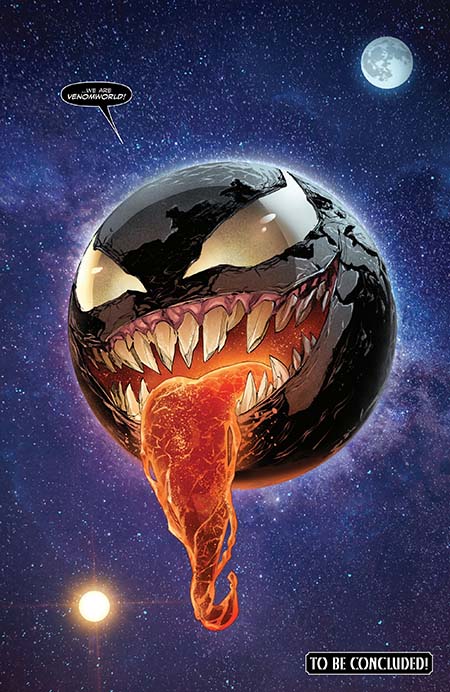
Spider-Man's Ex-Wife is Venom, and she just took over the world in an effort to repel the combined forces of an alien embodiment of destruction and a Norse Goddess of Death.

venomworld.jpg

Comics, everybody!
 
Back
Top