

not many games can claim to have their entire legacy erased by legal issues, but this is one notable example.
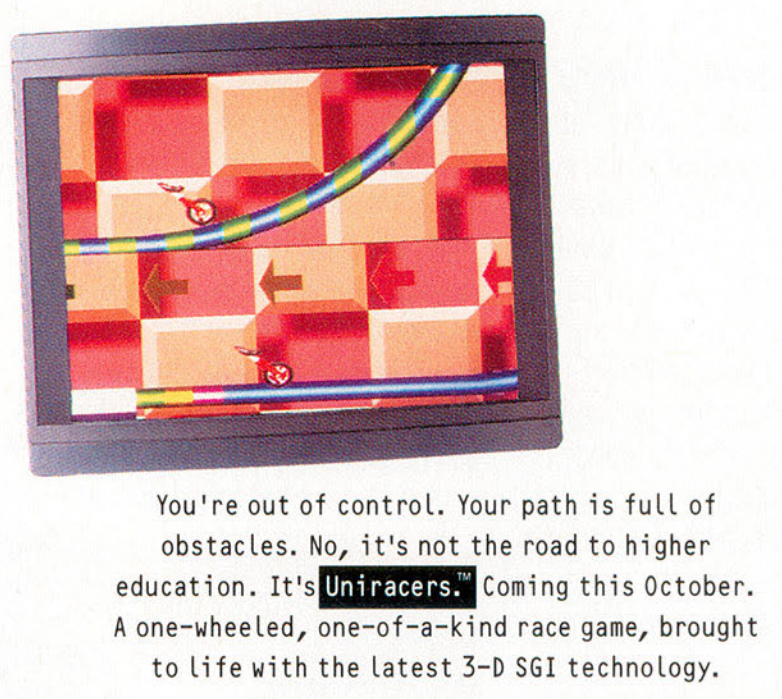
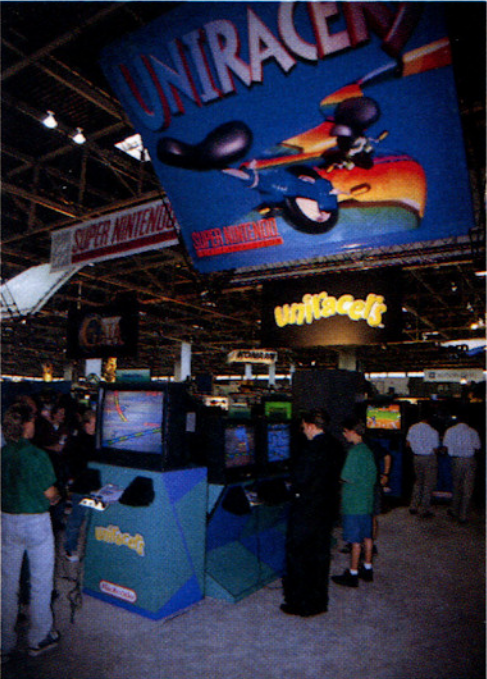
originally shown off by Nintendo at the 1994 Consumer Electronics Show and developed by DMA Design ("the top dreamy Scottish blokes wot invented Lemmings" as one magazine described them) Uniracers became public knowledge around the same time as Donkey Kong Country, being part of Nintendo's heavy push to utilize pre-rendered graphics in their published games. described under the marketing term of "Advanced Computer Modeling".
- from issue 6 of EGM2Nintendo kicked off their campaign with a one-hour live conference hosted by Nintendo executives Minoru Arakawa, Howard Lincoln and Peter Main. The conference was held Oct. 19 in CompuServe's Electronic Convention Center. A second group of Donkey Kong experts hosted a one-hour live conference Nov. 8, to discuss Nintendo's proprietary technology. During the second conference the panel answered questions on the Advanced Computer Modeling (ACM) technique used in the programming of DKC. We learned that Uniracers is the next game using the technology and it's coming out in the middle of December. More than 8,000 frames of animation were generated.
Nintendo also hinted that they have other games using the technology in development.
- from issue 12 of Edge Magazine
one Wired article about Nintendo's "Treehouse" division lists it alongside KI as well, another major 1st-party release using pre-rendered graphics.
Williams and a few other chosen ones were again called over the walkway to corporate offices in June 1994. This is where the magic happens. A cluster of offices and conference rooms, named the Treehouse after Donkey Kong's digs, is accessible only with proper security clearance. The three games under development at the time were Killer Instinct, Uniracers, and Donkey Kong Country, the huge NOA release last year.
The Treehouse is where the brain trust of producers, consultants, licensees, and execs formulate and decide the fate of Donkey and Diddy Kong. And this is where Donkey Kong Country was nurtured into the fastest-selling game in videogame history, pushing 500,000 units in its first week in release and well over 7.5 million copies to date.
the marketing was bold, this was the time where "Play it Loud!" was the big slogan. attempting to fill their copy with pure attitude in an attempt to compete with SEGA.
this "loud" advertising extended to here as well. with Nintendo sponsoring unicyclist Constance Cotter to ride a 16-foot long one at the Mall of America. (this was once the record for tallest unicycle. but it's been long since surpassed, with the most recent record topping out at 43 feet)


it could have the potential to become a cult classic, but it only got a single print run thanks to a lawsuit.
the story was first told in an issue of GamesTM magazine released in 2007.
ominous rumblings were emanating from the offices of Pixar Animation Studios, producers of Disney-marketed hits such as Toy Story and The Incredibles. Although back then the company had yet to achieve the worldwide fame they now enjoy, they were still brave enough to take Nintendo on over what they perceived to be wholesale theft of one of their ideas.
The problem centred on the Pixar animated short Red’s Dream – produced in 1987 – which featured a cute little unicycle not entirely dissimilar to the ones seen in Unirally. Pixar accused DMA of copying the idea and promptly sued.
Although the DMA team were obviously aware of the short film, plagiarism is something that Dailly refutes to this day: “We modelled the unicycle exactly, based on a real life unicycle. The problem with Pixar was that they seemed to think that any computer generated unicycle was owned by them. They took footage from Red's Dream and compared it to Unirally and the unicycles were virtually the same; this isn't a big surprise as there’s not a lot of ways you can bring life to a unicycle without looking like the one Pixar did. The judge - being the moron that he was - agreed. While it was a unicycle, and did look similar, I think he should have looked at the game as a whole. If he had, then he would have noticed that the game was a completely different environment, and the ‘character’ of the unicycle just wasn't the same.”
there's been some recent doubts if the story was being remembered correctly over the past few days, but the discussion led to the actual case files being recovered. showing that it did happen in some form.
Mike also made his own statement in response to this.
I spoke to Colin Anderson (musician on Uniracers, GTA etc) last night, and he remembers exactly the same as I do. In fact, he also remembers seeing the same video I did, that had the Reds Dream unicycle, rocking on It’s wheel, and a Uniracers unicycle doing the same animation – side by side, however out unicycle was vastly slowed down to match. This was part of the evidence Pixar submitted.
He also remembered the stopping of making more carts at 300,000, which was a short run by Nintendo standards, we’d have expected over a million.
The lawsuit would have been with Nintendo with them being the publishers, but like all publishers, they’ll hold developers liable for any claims, meaning and judgment/settlement ultimately fell onto DMA.
The part that will be unclear is how it ended. I did totally forget to ask Dave on Firday, as it was a busy day and just totally slipped my mind. Both Colin and I suspect it was “settled”, but I believe it was told to us that Pixar “won”, and that won’t necessarily mean that the judgement came from a judge, we may have well just made that leap at the time. However, I very clearly remember asking how they could claim ownership over every digital unicycle back then, so it’s not miss-remembering. But it may well depend “how” we were told, and that I can’t remember.
thankfully the incident didn't immediately kill DMA's relationship with Nintendo. not only were they briefly tasked with making a Kirby game, they were part of the "dream team" of Western studios Nintendo enlisted to make projects for the then-upcoming Nintendo 64.
Project Reality moved another step forward as Nintendo reached an agreement with DMA Design Ltd. of Scotland. DMA (best known for the hit game Lemmings) will develop software for the 64-Bit Project Realtiy game system now in development for Nintendo by Silicon Graphics. of David Jones, Managing Director of DMA, explained: "I have had the advantage of viewing the early stages of virtually every 'next generation' video game machine being developed in the world. And there is no question in my mind that Project Reality is in a class by itself."
the big intended project to come out of this partnership was Body Harvest, which ended up being published by Gremlin (and Midway in the US) after suffering severe development issues.
DMA Design's Body Harvest has had its share of publishing problems. The unique title was originally scheduled to be published by Nintendo, but inside sources suggest DMA Design and the big 'N' disagreed on the direction the game should take. Nintendo wanted the development team to incorporate RPG elements into Body Harvest, whereas DMA was banking on the game's action emphasis. One way or another, the two companies did not see eye-to-eye and as a result Body Harvest was put on the back-burner.
and of course. DMA would eventually become Rockstar Games, becoming massively well known after creating the Grand Theft Auto series.


