
-
Welcome to Talking Time's third iteration! If you would like to register for an account, or have already registered but have not yet been confirmed, please read the following:
- The CAPTCHA key's answer is "Percy"
- Once you've completed the registration process please email us from the email you used for registration at percyreghelper@gmail.com and include the username you used for registration
Once you have completed these steps, Moderation Staff will be able to get your account approved.
You are using an out of date browser. It may not display this or other websites correctly.
You should upgrade or use an alternative browser.
You should upgrade or use an alternative browser.
I had a good feeling! Celebrating 40 Years and 108 JRPGs of Destiny
- Thread starter Lokii
- Start date
-
- Tags
- shrug life


89. Fire Emblem: Path of Radiance
Intelligent Systems, 2005: GameCube. Points: 187 Votes: 5
Chapter 11 of Path of Radiance, “Blood Runs Red,” plays out in typical Fire Emblem fashion. There are a number of enemy soldiers to dispatch, houses to save from pillaging thieves, a Master Seal waiting to be relieved from a smarmy boss. But this chapter also breaks the rules of good decorum in the best worst way with an unfair ambush spawn. Should you be foolish enough to approach the boss while also leaving a unit near a totally innocuous and unassuming house… welp, out comes the Black Knight and that unit is no more.
The Black Knight makes his dramatic entrance earlier in the game via the cutscene assassination of protagonist Ike’s father, however here is the first time you encounter him in battle. He appears without warning, just when you think you’ve got the encounter in hand and only the boss to mop up. An imposing figure, the Black Knight. His map model is huge and solid compared to others, an iron tank of a unit, with Sauron-like helm and pauldrons wide as he is tall. He arrives at the start of the enemy turn, which means he gets to act before you have a chance to respond to his surprise appearance, and if one of your units is in range he will walk up and slaughter them. There’s no avoiding it. If he can reach a unit, they’re dead. Remember too, this game is from before Fire Emblem lost its spine and began catering to cowards with namby-pamby casual modes. A dead unit is gone for good.

The Black Knight is impervious to every attack. There’s nothing you can throw at him that will make a scratch on that imposing armor. Your only recourse (after reloading a save to restore your unfairly massacred unit and play the chapter through again) is to run away, keep every unit out of the path of his grim march, and dispatch the mercifully easy boss to end the chapter as fast as possible.
This is unequivocally bad map design; unfair and inept, the kind of thing that puts FE players’ teeth on edge. But oh what an impression it makes. This iron angel of death, mysterious and unstoppable, reaping his way through your army, is not something that’ll soon be forgotten.
This encounter also sets up the climatic rematch. A dozen chapters and a class promotion later, Ike faces down the Black Knight in a one-on-one duel. There are several ways this can play out but none of them have an impact on the story or result in a game over, only varying the prize awarded. Perhaps the most common case is the Black Knight wipes the floor with Ike. This isn’t a story encounter and, as we know, the Knight’s no slouch. It takes a god-blessed blade and careful build planning to secure enough advantage to topple ol’ Ironsides. But there’s another option besides glorious victory and ignoble defeat: cowardly prudence. If you want, right at the start of the duel, you can move Ike to the room’s doorway and peace out.

Chapter 11, with its unfair ambush and imposing death march, has set up an expectation that all three of these outcomes satisfy. Based on the impression ‘Blood Runs Red’ left on the player, they will either inhabit an Ike who has trained for this moment of retribution, one who bravely charges in against an impossible foe, or one who prudently and wisely beats the retreat. All three of these are viable resolutions to the combat situation and all three are viable responses to getting bodied in Chapter 11.
Sometimes you hear the argument that JRPGs aren’t actually “role-playing” games because they lack the kind of impactful choice-making found in games like Planescape and New Vegas. But it’s not that JRPGs lack role-playing, but that the kind of role-playing they enact is of a different sort. Here, the player doesn’t have a choice but to ‘role-play’ out one of these resolutions. Still, the emotional flavor of the moment, the completion of a character arc, is brought into existence via the player’s choices regarding the mechanical systems; and so a story is told. The Black Knight in Path of Radiance is a salient example of how breaking the rules can be used to good effect and just why we call these dumb things ‘role-playing games.’


I rated this low on my list but that was before it was added to the Gamecube app, where I gave it a proper and full revisit that got me past the part I always got stuck on (the first ship map, to be clear) and to the end of the game, where I fell in love with a lot of what PoR brings to the table. I'd put it considerably higher now.

Violentvixen
(She/Her)
I didn't have a Gamecube so played Path of Radiance way after playing some other games in the series, but it's so dang good. I went back and looked at my list and I wish I'd rated it higher. Oh well!


FelixSH
(He/Him)
I played this two decades ago, or so, but only up to a stealth map. I probably lost a unit, because I know I didn't win the map, and that is the only reason why I wouldn't (no one gets left behind). Which lead me to stop playing. A shame, I enjoyed what I played of it a lot, the characters are cool.

Path of Radiance is a GOAT, and one of my favourite Fire Emblem games, but I don't know that I actually have all that much to say about it. I have my original copies of both it and its brother on my shelf, but I'm glad that it's more widely available now (it's price-prohibitive to buy second-hand), so that more people can play it!
PoR has some of my favourite encounter designs in the series, with some really memorable ones. That point defense mission where you're repelling invaders from a keep as they approach from all sides lives rent-free in my head, and apparently I'm not the only one, as it was revisited in the recent Engage with a really fun twist. It also has possibly my favourite Jeigan (FE jargon for a pre-promoted unit that starts out way stronger than all of your other units but ends up weaker and that you are disincentivized to actually use lest they suck up all the XP) in the series in Titania, a giant bad-ass horse-riding redhead with an axe. Missions like that fort defense basically force you to use her, which will lead you to discover that, unlike basically every other similar unit in the series, she's actually really good and will continue to get better, and you can and should make the most of her. Titania is just one of many great, memorable characters, though, including such series favourite as Elincia, a staff-wielding Princess riding a Pegasus, and Soren, Ike's gay nerdy best friend who {spoiler}.
Speaking of XP, though, PoR introduces a mechanic I really like in the form of Bonus XP, a pool that you gain points in by performing well after each battle and can then draw from back at base to gift XP to under-levelled units directly instead of goofing around with them in battle. This is one of many new wrinkles that PoR introduces into the classic formula, not all of which are great (I think the skill system here is needlessly fiddly compared to others, and the optional fixed stat growth system for boring people takes all the fun out of levelling), but many of which are really fun. Supports were reworked here in a way that I much prefer, where units gain support simply by being deployed together, and have their Support conversations back at base, instead of on the battlefield. Shoving was a new battlefield mechanic whereby units could push another unit a single space away (or, in the case of Big, push two spaces), and was leveraged heavily in strategic positioning throughout. And finally, Forging was a fun new mechanic where you could create special versions of generic weapons with tweaked stats (if, say, you wanted a special lighter sword for low-STR characters to wield, or a higher-crit weapon, etc), and then could also give this new version a different colour and a unique name and see it wielded in battle, which was both a fun opportunity for additional roleplaying and/or jokes, as well as a way to show off the new 3D combat engine. The game definitely relished in letting you rotate around your fun new orange axe named Percy or whatever. This move to 3D felt revolutionary at the time, but its unfortunately pretty rough to look at now. It definitely looks better in my memory!
All of these changes are in service to a pretty compelling narrative about fantasy racism where you and your new animal buddies (another new mechanic) try to convince everyone to work together for the common good despite an unseen hand that really wants everyone to fight each other instead. You're literally herding cats!
Anyway, I highly recommend both PoR and [redacted] (which I hope to have the opportunity to discuss later, but probably wont) if you missed them back in the day, which, chances are, you did, because this game did not sell nearly as well as it deserved to. Ike is more than a big guy with a sword who beats up Star Fox and Pikachu! He's big guy with a sword and a cool dead dad! Inquire within!
I like the biometrics system too, where characters' internal wellbeing will shift in an out of season. It doesn't quite work out practically, but I like the sentiment behind it to encourage army rotation and it seems like a mechanic that could be refined should IS ever revisit the idea.

my first and favorite fire emblem game. certainly related as i played it quite a few times when i had fewer contemporary games, but it's also just kind of...pleasantly straightforward. the character building isn't super complex and there aren't any endless/long side grinds, nor the kinds of recurring activities in something like 3h.
the thing lokii mentioned about role-playing is also how i feel about numerous games i voted for. which doesn't include this one but i do still like it
the thing lokii mentioned about role-playing is also how i feel about numerous games i voted for. which doesn't include this one but i do still like it

Path of Radiance is not a beautifully-animated game, nor does it give you many exploitable tools to do hilarious nonsense (but check out how good Vantage is in this game). But in all other respects it's pretty much still the best game in its series. The writing is intelligent and punchy, the cast is pleasant and interesting, the level design is varied and memorable, and all of its peripheral mechanics like support work in a much more elegant way than their equivalents in its successors.

R.R. Bigman
Coolest Guy
I liked the one Fire Emblem game I played well enough, Awakening, but I don’t think the series is for me. The entire crux of the game was built on the idea of not losing any of your wacky pals in combat, so starting on Casual, where you can simply use human wave tactics to beat everybody, destroyed all challenge. When I switched over the game to Classic and played it For Real, it turned into a slog where a bad RNG or enemy ambush would force me to start an entire mission over. Neither version of the game was a
great time for me.
Also, having nearly all of the unit characters permanently killable\missable means they can’t participate in the story once they hit the battlefield, with only a couple exceptions.
great time for me.
Also, having nearly all of the unit characters permanently killable\missable means they can’t participate in the story once they hit the battlefield, with only a couple exceptions.

Regulus
Sir Knightbot
For what it's worth, if they're able to Die For Real, most units do not actually spend much time participating in the story and it's functionally impossible to field all of them in most of the games anyway (Awakening is one of the exceptions due to its structure). Technically the games are built around the possibility of losing a few units as you go through the games. Some more than others, like the Archanaea games which hand out recruits like candy.
So... there might be a middle ground for you? Though personally I understand the desire to restart in order to keep units you've been investing in, and can also see how restarting maps for individual errors might feel like a slog. More recent entries do tend to include an "Omega 13" button that lets you wind back time a limited number of times per battle, which I think is a good compromise.
So... there might be a middle ground for you? Though personally I understand the desire to restart in order to keep units you've been investing in, and can also see how restarting maps for individual errors might feel like a slog. More recent entries do tend to include an "Omega 13" button that lets you wind back time a limited number of times per battle, which I think is a good compromise.
Violentvixen
(She/Her)
I completely forgot about this system until right now. It would be interesting to see this return!I like the biometrics system too, where characters' internal wellbeing will shift in an out of season. It doesn't quite work out practically, but I like the sentiment behind it to encourage army rotation and it seems like a mechanic that could be refined should IS ever revisit the idea.
Anyway, Awkward Zombie time
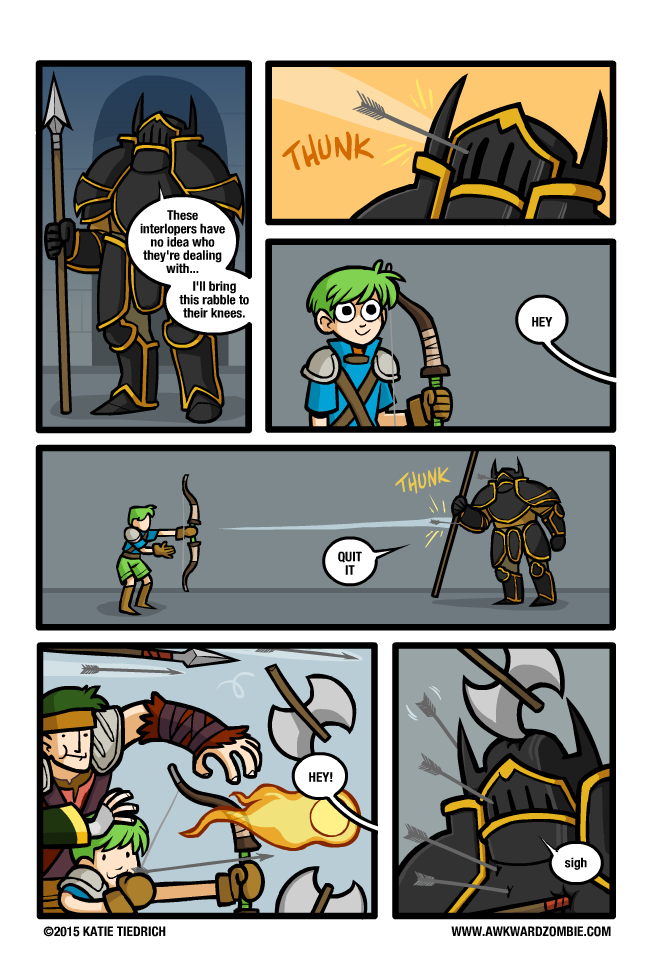

I didn't end up voting for a Fire Emblem, but Path of Radiance would've been on my short list of entries to nominate. It wasn't my first FE, but I believe it was the first one I played on a console. The presentation was just fantastic and made a great first impression, and as it turns out the gameplay is also really good.

Sarge
hardcore retro gamin'
I've only actually beaten one Fire Emblem, despite buying... well, pretty much all of them. And that's the first GBA release we got. I have a friend of mine that thinks this (and Radiant Dawn) are fantastic, though. The permadeath thing is pretty harrowing, and it's no fun keeping a unit out of harm's way until, oops, reinforcements spawned in next to them! I definitely get why the series has so many fans, even if I tend to not stick with them.

For what it's worth, if they're able to Die For Real, most units do not actually spend much time participating in the story
I think this is what @R.R. Bigman is complaining about - most recruits have no significant role in the story because of how hard it would be to write the game to accommodate for any given character possibly being alive or not at any given time. I think that’s what the supports are for - little bits of characterisation that are simply on or off depending on if the character is alive and in use or not. The other way FE characters participate in the story of course is through their use in the stages. Usually some otherwise unimportant character who gets a lot of good RNG in their level ups makes their own story of just reliably dominating in the field.
Lokii’s writeup has me wanting to play it again.
Update:

Also fun fact: I lent my friend my copy of this game I originally bought for like $60. At some point he purged it from his collection so I had to just write that off, and by that point the game cost a bit more than $60. So now I'll have NSO to play it again, at least (and tbh I wouldn't want to hook up my Wii to play it legit, I don't even remember if it can read GC discs).
Regulus
Sir Knightbot
I think this is what @R.R. Bigman is complaining about - most recruits have no significant role in the story because of how hard it would be to write the game to accommodate for any given character possibly being alive or not at any given time. I think that’s what the supports are for - little bits of characterisation that are simply on or off depending on if the character is alive and in use or not. The other way FE characters participate in the story of course is through their use in the stages.
Oh, you're right, I totally misinterpreted that.
I suppose that's part of why support conversations are a thing, but they are often (usually?) completely removed from the main story. At best characters may have conversations with a boss unit or two that are relevant to their backstory. Or not all that relevant, in the case of something like Stefan and Homasa, to bring things back around to path of Radiance.
Tactics Ogre has a similar approach where characters, missable or otherwise, often have substantial dialogue with enemy units and allies mid-battle. Some of the best writing in the game is actually in these mid-battle exchanges, I think. Most of the additional script in the new FFT release is handled this way, too. It goes a long way toward making the less consequential characters feel more relevant.

88. Bravely Default
Silicon Studio, 2012: 3DS. Points: 189 Votes: 4
It plays out like this: the world is diminished and can only be restored by reviving the four elemental crystals. You travel from location to location, facing a number of difficult bosses themed after Final Fantasy job classes (and acquiring the use of those jobs in the process), overcoming the regions’ guardians and activating their crystals, all at the direction of Airy, the sassy and butterfly-winged fairy mascot. This endeavor represents a normal amount of JRPG content, roughly fifty hours of gameplay. But then, upon lighting the final crystal and at the moment when normally the game would introduce its final dungeon, the player finds themselves whisked back to the very beginning. At first they’re mystified. Does that madman Asano and his cortege of sickos at Silicon Studio really expect them to play through the whole game again? Indeed they do. And aside from some altered dialogue and one significant detail recognizable only to the most eagle-eyed, the game plays out exactly as before, with the same bosses and challenges. There has to be a reason for this, right? Surely everything will be revealed if the four crystals are once more revived. And yet upon finishing the world-spanning task once more, the player finds themself back at the start. And will so again, and again, and again…

Why do this? Why burden the player with such an extreme amount of repetition and tedium? It’s a dangerous move, one that threatens to (and in fact did) alienate players from a sense of progress and discourage them from continuing. It’s too outrageous and costs too much of the player’s goodwill to be written off as mere padding. This is a deliberate choice, a purposeful injection of monotony into what was until this point a perfectly engaging bit of JRPG progression. Considering its intentionality, we can look at its effect in the game and suss out the reasons why Team Asano chose such a hostile structure.
For one, it creates a kind of extended post-game. To call Bravely Default mechanically robust would be an understatement. It is a marvelously rich game, with deep systems and difficult enough to force you to engage with and exploit them. The restarts give the player opportunity to really explore the jobs they acquired during the first go-around, to unlock their full potential and discover effective synergies. Despite the repetition, the player is uplifted as bosses that once seemed impossible roadblocks go down with an ease and quickness that increases with each loop.

The other major reason for this long looping detour is a commitment to story and emotional resolution. The narrative reason for the restarts is eventually revealed as the master plan of the generic dark-force villain who wants to destroy the world. He’s been manipulating things very much from the background and would come across as a hastily introduced final boss if things had progressed normally. However, when the reveal comes after loop upon loop of repetitive crystalmaxxing the sense of anger, betrayal, and complicity the player feels has been tempered in the fires of needless repetition and forged into a righteous drive that lends the final encounters a poignancy that is hard to deny. If a JRPG can be measured by the emotional state the player brings with them into the final battle then Bravely Default ranks among the best.
Sarge
hardcore retro gamin'
Bravely Default was rad. You'd think it wouldn't appeal to a guy that doesn't much care for FFV, and bounced off of 4 Heroes of Light, but I shredded through this one without a thought. The looping structure towards the end I think worked plenty fine - as you say, it encourages you to delve into the job system and exploit the heck out of it. The payoff at the end was absolutely worth it.
Now I need to find time to play through Second Layer and BDII...
Now I need to find time to play through Second Layer and BDII...

I ranked BD pretty highly, if I recall correctly. I was so engrossed in the battle and job mechanics that I didn't even mind the repetitiveness - and I played the original JP release before all the extra features were added, so it was even more repetitive! Another thing is that the soundtrack is fantastic, with so many bangers. I'll have to listen to it later and pick some examples to post.
I never did play Bravely Second, which I hear is also very good. I need to get around to that one of these days.
I never did play Bravely Second, which I hear is also very good. I need to get around to that one of these days.


I didn't get all that far into Bravely Default. Loved just about everything about the game, but it's a little too old school and my swiss cheese brain just doesn't have the patience for games like this anymore. If I had played this game when I was 12, it probably would have been an all-timer for me. Glad it's getting a Switch 2 port.


4-So
Spicy
Bravely Default certainly is memorable enough but put me in the camp of people who thought the time-loop conceit was better in theory than it was in practice. Kinda tedious, honestly, and while I understand it provides a kind of emotional weight that wouldn't be possible otherwise, I just don't want to, you know, actually play the latter part of the game. But those first four chapters? Pret-ty good.
I don't know anything about the game, but I love bravely defaulting on my loans.
This is actually how the battle system works